
Why “hot take” content is winning on LinkedIn right now (and how to write yours)
I've been noticing the past month what's actually working across client pages and personal profiles on LinkedIn, and one pattern keeps showing up: editorial, opinion-led content is outperforming generic posts.
We are talking about a pattern I've seen repeat across different industries, different page sizes, and both company pages and personal profiles.
Here is what's happening, the reasoning behind it, and exactly how to write a post that uses it.
What's actually happening with the algorithm
LinkedIn's algorithm has been in flux and reach has dropped for most accounts over the past while.
If you haven't seen my breakdown of those changes, it's worth a read before this one, because it explains a lot of the "why" behind what I'm about to describe.
The good news: reach has started picking back up recently for a lot of accounts I work with.
The slightly more cautious news: I wouldn't get too excited yet. One good week doesn't mean the algorithm has settled. But the timing lines up with something else I'm seeing, which is that the type of content earning that reach has shifted.
The pattern: story + unique angle beats generic advice
I’m noticing that posts that comment on a news story, a trend, or an industry development, with a clear personal opinion attached, are consistently outperforming posts that just share generic tips or "here are 5 things about X."
I tested this on my own profile first. A post I wrote about company pages and employee-generated content (EGC), where I featured an actual article and gave my take on it, got better-than-average reach and engagement.
Even better, it reached people well outside my existing network. This is always a good signal to look at.
I've since seen the same thing play out with several clients, on both personal profiles and company pages.
With the extended use of AI, we are already tired of the polished, generic, or safe “thought leadership” posts that could be written by anyone.
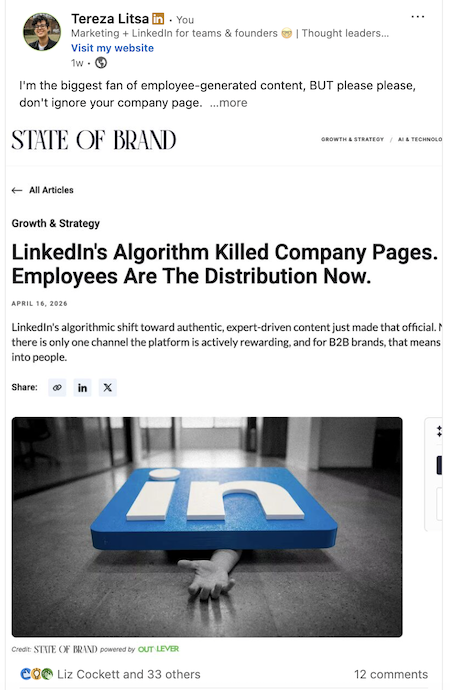
Story + opinion = something genuinely new to say.
And "new to say" is rare on LinkedIn right now, which is exactly why it stands out.
Why this works (beyond the algorithm)
There's a practical reason behind this, not just an algorithmic one. LinkedIn feeds are saturated with generic, interchangeable content: the same listicles, the same "unpopular opinion" openers that aren't actually unpopular, the same motivational quote dressed up as insight. Audiences have gotten very good at scrolling past it.
A genuine point of view breaks that pattern. It signals there's an actual person behind the post, not a content calendar. And LinkedIn's own incentives (engagement, comments, dwell time) reward that, because disagreement and reaction generate exactly the signals the algorithm is looking for.
This also matters beyond LinkedIn itself. As more people search using AI tools and LLMs to research people and companies, the content that gets surfaced and cited tends to be the content with a distinct, well-reasoned perspective, not generic restatements of common knowledge.
Clear opinions, backed by reasoning, are simply more useful to summarise and reference than safe, vague posts.
“Writing with a genuine POV is becoming part of how you show up in AI-generated answers, not only in the LinkedIn feed.”
How to actually write this kind of post
This is the part most people get stuck on. "Have a unique POV" is easy to say and hard to do on demand. Here's the practical process I use with clients.
Start with a reaction, not a topic
Before you open LinkedIn, read something. An article, a report, a piece of industry news, even a post someone else wrote.
Then ask yourself three questions:
How do I actually feel about this? Not how you think you're supposed to feel. Your gut reaction is the seed of your angle.
Do I agree or disagree, and why? If you agree, what's missing from the conversation? If you disagree, what's the counterargument nobody's making?
What's the takeaway for my audience specifically? Not "this is interesting," but what should someone in your industry actually do differently because of this?
If you can answer those three honestly, you already have a post. The structure almost writes itself: here's what happened, here's what I think about it, here's why it matters to you.
Take it further than the obvious reaction
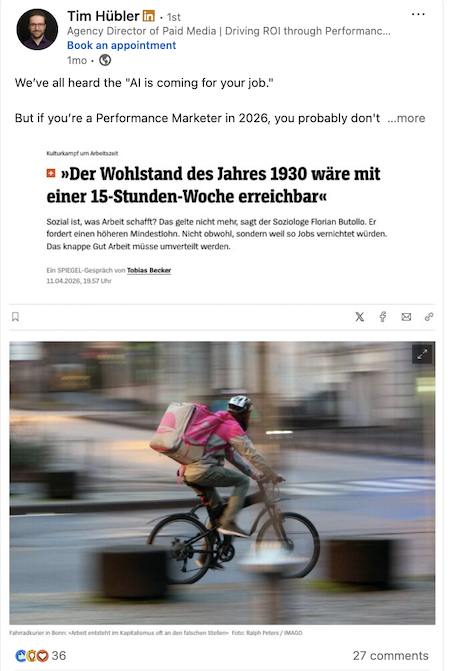
The first reaction most people have to a story is also the most common one. That's fine as a starting point, but push past it.
Ask: what's the second-order effect? Who does this actually impact that isn't being talked about? What would I tell a client about this in a five-minute conversation?
That extra layer is what separates "I read this article and here's a summary" from "I read this article and here's something you haven't considered yet."
What if there is no article? Use a trending topic in your space
You don't need a specific news story to do this. If nothing's landed in your feed recently, ask what's currently being discussed in your field, what people are debating, what's changing. Then apply the same three questions: how do I feel about it, where do I land, and what should people do with that.
The format doesn't need a "source." It needs a clear position. "Everyone's talking about X right now, here's where I disagree" works just as well as commenting on a specific article.
To clarify, I am not encouraging the posts that are provocative for the sake of having a polarising opinion. Yes, they can get engagement, but what will you get out of it?
Write the opinion first, then build around it
A common mistake is writing a balanced, neutral summary and then bolting an opinion onto the end. Flip that. Write your actual point of view as the first or second line. Then use the rest of the post to justify it, give context, and bring it back to a concrete takeaway.
If someone only reads your first two lines, they should already know exactly where you stand.
Keep the takeaway concrete
Opinions land better when they end somewhere useful. Not just "this is bad" or "this is exciting," but "here's what this means for how you should think about X."
That's what turns a hot take into thought leadership rather than just a rant.
The shift, in short
Generic content isn't dead, but it's no longer very effective.
What's working right now is editorial: reading something, forming a real opinion about it, and saying it clearly enough that people either agree loudly or push back. Both reactions help you. Neither happens with a safe, generic post.
If you're not sure your content currently has a strong enough POV, a useful test is this: could someone else in your industry have written this post, word for word, and would it sound exactly like them? If yes, it's too generic.
If your opinion is specific enough that it could only have come from you, you're on the right track.
I work with founders, executives, and brands on LinkedIn brand strategy and personal thought leadership, helping them build visibility, sharpen positioning, and find the unique perspective that actually cuts through.
If you're rethinking your content approach, I'd be happy to talk it through.