
Thought leader ads, explained: how they work, and why you should add them to your strategy
We don't talk enough about my favourite ad format on LinkedIn, thought leader ads.
I get asked about them constantly, what they actually are, how they're different from a normal boosted post, whether they're worth the setup faff, what they're actually good for. So here's everything in one place.
What are thought leader ads?
The simplest way to explain it: you boost an individual's organic post, so it runs as paid distribution behind a real person's content instead of your company Page's.
The nerdy way to explain it, and how I actually approach it with clients. is that you identify an opportunity as part of a campaign or objective, then draft organic posts that are built to work for both organic and paid from the start.
(Yes, that means not every post magically works. There's strategy behind it)
The reader's experience matters here: the ad still shows up in the feed as that person's post, with their name and photo attached, not as a company ad unit. It reads as a person's opinion, not a brand placement. That's the entire reason the format performs differently.
How they actually work
This is the part most people skip, and it's where a lot of "why didn't this work" problems start.
Permission is required, always. You can't sponsor someone's post without their explicit consent. They'll get a request through LinkedIn and have to approve it before you can promote anything.
Only two campaign objectives are supported: brand awareness or engagement. There's no conversions or website-visits objective for thought leader ads, which immediately tells you what the format is for (and isn't for).
Only certain post formats qualify: text-only, single-image, native video, event posts, and articles or newsletters. Documents, polls, multi-image posts, celebrations, and reshared posts aren't eligible.
It has to be a real, already-published organic post. You can't draft new copy inside Campaign Manager and launch it as a thought leader ad, the post has to exist and be live first.
The thought leader can revoke permission at any time. If they do, the ad turns off immediately. That's worth knowing before you build a campaign entirely around one person's content.
Measurement blends organic and paid. The individual can see the combined total of organic and paid engagement on their own post, and metrics like member follows, clicks to profile, and dwell time sit alongside the usual CTR and CPC, which is part of why this format needs a different scorecard than a standard ad (more on that below).
None of this is complicated once you know it. But it does mean thought leader ads take more lead time than duplicating a company ad and swapping the creative.
Why you need both an organic strategy and a paid strategy
People think a thought leader ad is just a boost button. Pick any decent post, throw money behind it, watch the magic happen.
It doesn't work like that, the post has to already exist organically. Your organic strategy is your paid creative pipeline. If you're not deliberately posting with this in mind, you won't have anything worth boosting when the moment comes.
Here's how I actually approach it:
1. Start with the campaign objective, not the post. Say you want to promote an event. You build thought leadership content into the plan from the start, written in a way that a) attracts organic engagement and b) works as an ad. That's a different brief to "write something LinkedIn-y and we'll boost whatever does well."
2. Let it prove itself organically first. Always give a post room to get organic traction before you boost it. Whatever's already working organically, the hook, the specificity, the voice, gets amplified by paid. Whatever isn't working organically won't be rescued by budget.
3. Draft with intention. Not every post will land. You still need to understand how LinkedIn actually rewards content, a specific number, a real opinion, a recognisable voice, before you decide what's worth putting money behind.
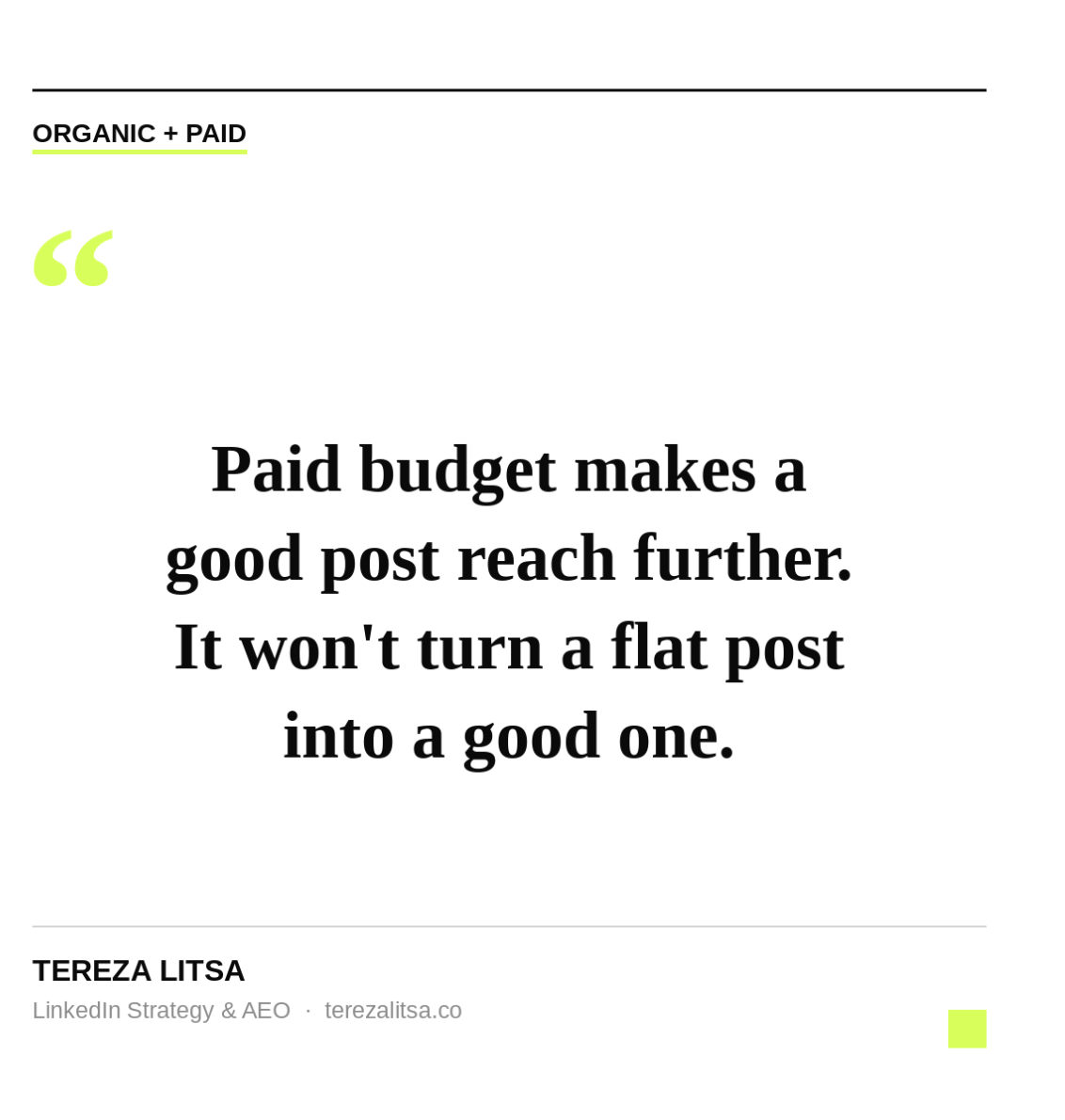
4. Treat paid as amplification, not correction. Paid budget makes a good post reach further. It won't turn a flat, generic post into a good one. If the organic version isn't earning comments and shares on its own, more spend isn't the fix.
This is the whole reason "organic and paid" isn't two separate teams or two separate calendars for this format. It has to be one plan, because one literally feeds the other.
Why you need a plan (not just a "good post" on standby)
A plan means three things, minimum:
Timing. Ideally you're planning thought leader ads about a month before your campaign, event, or launch — enough time for a post to earn organic traction before you put budget behind it.
Who's posting. Don't default to only the CEO or the "obvious" spokesperson. On a recent campaign, we tested going beyond the internal, expected experts and it still performed strongly. Thought leadership requires a genuine, specific point of view.
What you're measuring, and against what. Since only brand awareness and engagement objectives are supported, judging a thought leader ad purely on last-click conversions will make a genuinely strong campaign look like it's failing. Profile clicks, follows, comments, and dwell time are the more honest read on whether it's working. And of course, you can still access clicks to landing page if you want to measure site traffic.
Where thought leader ads actually fit (use cases)
Here's where it consistently earns its place:
Events and conferences. A speaker, host, or attendee posting about what they're looking forward to reads as genuine anticipation, not a company plugging its own event. Event posts are one of the few post types that get to keep a CTA button, which makes this a strong direct-response fit within the format's limits.
Case studies and client wins. A result narrated by the account lead or the person who actually did the work carries more social proof than the same result written as a company post.
Company milestones and announcements. Funding rounds, product launches, big hires — these land differently coming from a named person's own reflection than from a logo.
Building an individual's authority alongside the brand's. Since engagement and profile clicks are tracked, this format doubles as a way to grow a founder's or expert's own following while the campaign runs — a two-for-one that a standard company ad can't offer.
Recruiting and employer brand. A genuine employee post about what it's like to work somewhere tends to outperform a careers-page ad, for the same "people trust people" reason.
Where it fits less well: anything that needs a hard conversion, anything time-sensitive with no lead-in period, and anything where you don't have a person willing and able to post authentically in the first place.
A real example: two campaigns, same account, very different results
On a recent campaign, I saw thought leader ads pull 2x higher CTR than standard ad formats. On another, 2.55x ROAS, significantly beating ads coming from the company page.
So, why are thought leader ads still not part of your strategy?!
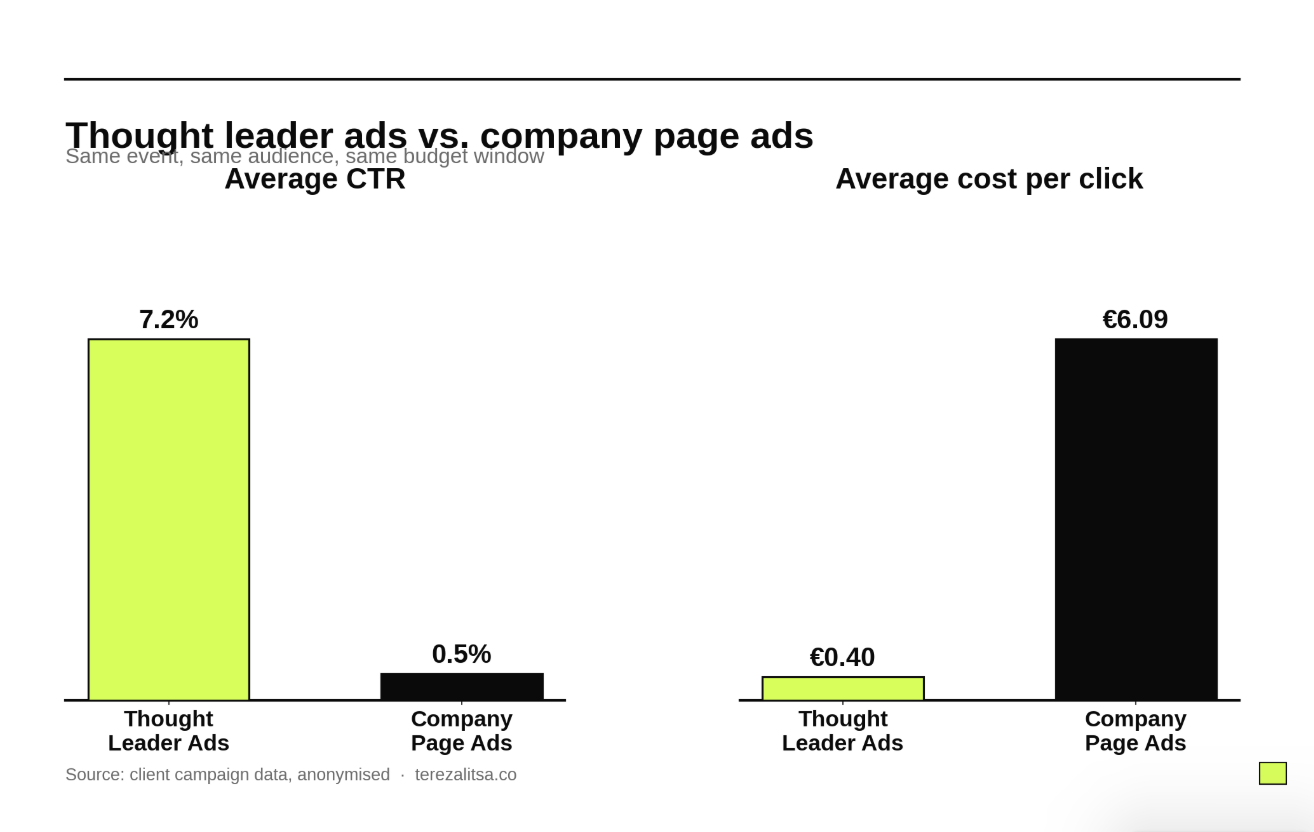
I recently ran two LinkedIn campaigns for a client who wanted to promote an upcoming event, side by side a thought leader campaign boosting posts from two team members and an external speaker, and a company-page campaign promoting the same event through single-image ads.
The thought leader ads landed a CTR of 6–8%, at a cost per click of around €0.40. Even better, the actual ROAS was 2.55x.
The company-page single-image ads landed a CTR of well under 1%, at a cost per click of €4–8. Same event, same audience pool, same budget period — a 10x+ difference in cost efficiency, in favour of the format that "just" boosted a personal post.
This is the part that matters more than the headline number: within the thought leader campaign itself, the posts didn't perform equally.
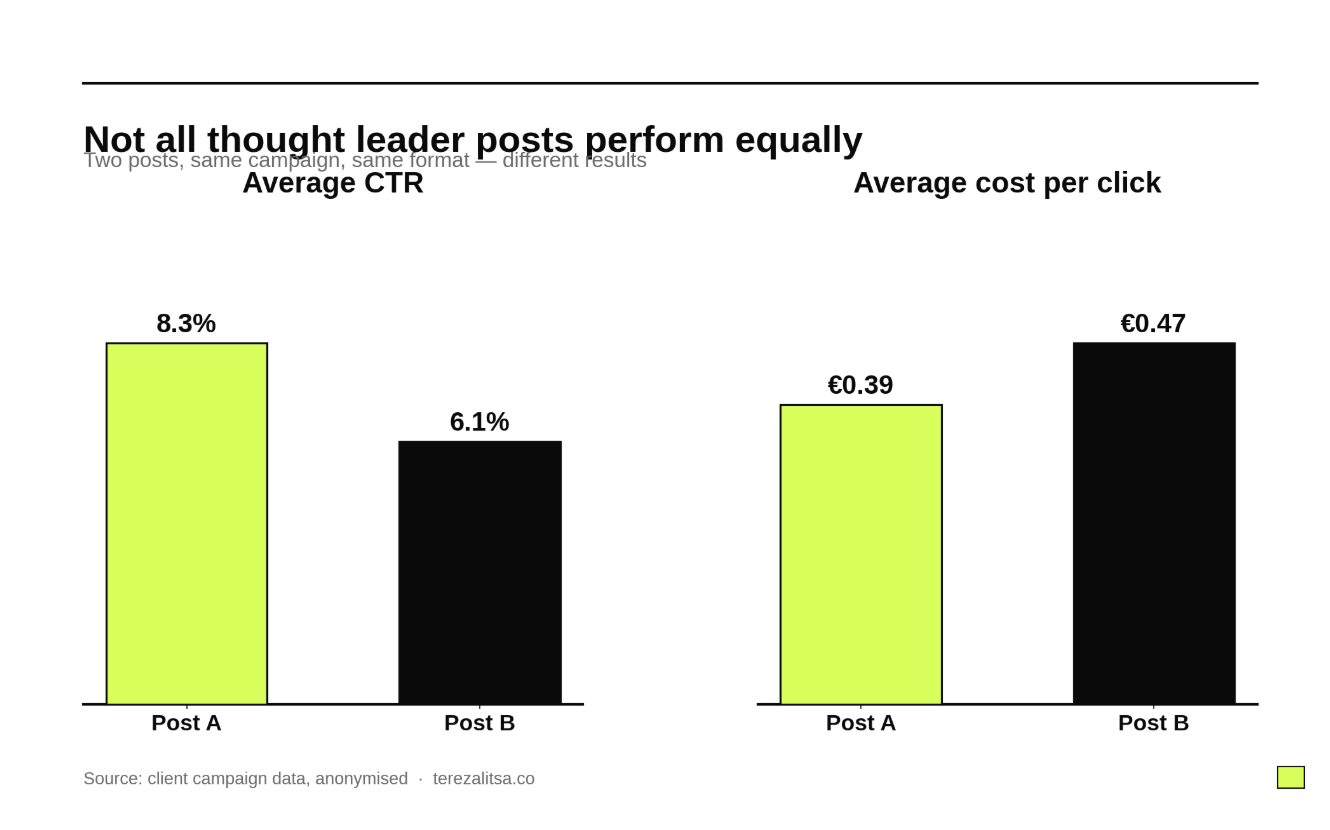
One consistently out-CTR'd, out-engaged, and out-converted the other, and it kept improving as we scaled the budget behind it, rather than flattening out the way paid creative usually does. The other post was still solidly above the company-page benchmark, but noticeably softer, and needed a copy refresh rather than simply more budget.
That's the point I want to land: thought leader ads as a format are more efficient. But which post you choose to boost, and how you write it, is still where the real work, and the real risk, sits.
The bottom line
Thought leader ads can be dramatically more cost-efficient than standard ad formats — the data backs that up, and so does my own client work. But the format doing the heavy lifting doesn't mean the strategy behind it can be an afterthought. The setup requires real organic content and real permission; the objectives are limited to brand awareness and engagement, not conversions; and the wins come from treating organic and paid as one system, planned in advance, not two separate jobs bolted together.
When it works, it's not luck. It's a draft that was built to work twice.
Need help with the strategy or the set up of LinkedIn Thought Leader ads?